About
Services
Emergency Dentistry
Same-day care for pain, swelling, breaks and knocked-out teeth — including a $29* emergency exam.

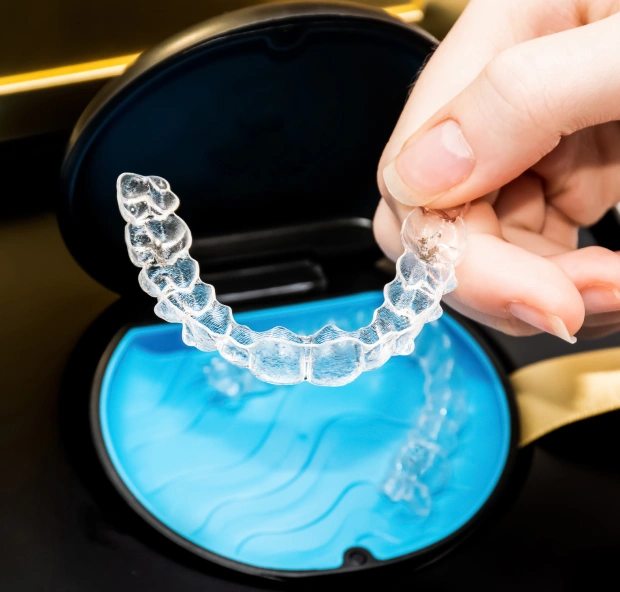
The most established clear aligner system, planned with iTero® 3D scanning — discreet enough for the boardroom, precise enough for real bite correction.
Invisalign uses a series of custom, virtually invisible aligners to shift your teeth gradually into position, closing gaps and correcting bite problems along the way.
Left uncorrected, misalignment contributes to speech difficulty, chewing problems, gum disease and in some cases sleep apnoea. Targeting the underlying alignment is what resolves those knock-on effects, not just the appearance.
Metal brackets have sharp edges that cut the inside of the mouth and leave sores that take time to heal. Smooth custom aligners avoid that entirely.
With fixed braces, food gets trapped and gum health suffers. Aligners come out, so you brush and floss normally with no special equipment.
Crooked, crowded or gapped teeth make people self-conscious about their own expressions. Aligners let you fix that without announcing it to everyone.
Ask about Vivera retainers when you finish. They use the same technology as the aligners themselves to hold your result in place.
Ideal for patients who want to straighten their teeth discreetly. The aligners are virtually invisible in professional settings and social gatherings.
Available with compliance indicators so parents and teens can track wear time. The obvious solution for student-athletes and musicians who need to avoid brackets.
iTero® 3D scanning lets Dr. Le plan these cases in our own studio.
A thorough assessment of your oral health first — we treat gum disease and decay before moving teeth, never alongside it.
3D scanners capture your teeth precisely, and Dr. Le maps the sequence of movements needed to get to the planned result.
Your measurements go to the laboratory and your custom aligner series is manufactured. Each set is worn for the period specified in your plan.
Reviews roughly every 10 to 12 weeks to confirm progress, make minor adjustments and catch any fitting issue early.
Cost depends on the complexity of your case and the length of treatment.
Most cases run somewhere between six months and two years. Mild crowding or minor relapse after previous orthodontics can finish quickly; bite corrections take longer. Dr. Le will give you a realistic estimate at your free consultation, once the 3D scan shows what actually needs to move.
20 to 22 hours a day. They come out for meals, drinks other than water, and brushing — that is the whole appeal. But wear time is the single biggest factor in whether treatment finishes on schedule, so the aligners need to be in for everything else, including sleeping.
Not painful, but expect pressure and mild tenderness for a day or two each time you move to a new set. That sensation is the treatment working. It fades as the teeth settle, and most patients find it noticeably gentler than the adjustment days that follow tightening fixed braces.
Some patients notice a slight lisp for the first few days while the tongue adapts to the aligners. It almost always resolves on its own within a week and is rarely noticeable to anyone else.
Many plans include orthodontic benefits that apply to clear aligners, though coverage varies widely and some plans limit orthodontics to patients under a certain age. Bring your details to the consultation and our insurance coordinators will verify your benefits before you commit to anything.
You will need a retainer. Teeth drift back toward their original positions without one, and retention is the part patients most often underestimate. We will cover the retainer plan as part of your treatment discussion so there are no surprises at the end.
Everything below is handled by the same team, in the same two offices. Back to Clear Aligners.
Book online in under a minute, or call and talk to a real person at the front desk — whichever you prefer.